
Take your prototype across the gap between lab sample and shelf-ready product
Without losing what made the sample work
No 'normal at scale.'
No 'how we usually do it.'
No silent substitutions you find out about after launch.
Before you sign a CMO contract on a prototype you believe is ready, see the gap a Master Formulator measures first
13 questions across 7 modules.
3 minutes to walk out knowing the gap
Free.
Yours to keep.
The
Lab to Market Readiness Score
is the entry diagnostic
The full operating system is what you take
When the diagnostic reveals more than three minutes can hold
If the readiness score surprised you
The product architecture you designed is where the gap began
Discover your Readiness Score
from 0 to 100
Plus a Drift Risk Map showing the 3 areas most likely to create late-stage surprises
13 questions
5 minutes - reveals your highest-risk gaps
What is the LULUBLE Lab to Market Strategy?
It’s designed to sit on your side of the table, as if your Chief Scientific Officer were in the room, so you can run product development and manufacturing with control, not guesswork. It is a founder‑ready, lab‑native roadmap: what to decide, what to test, what to lock, what to document, and what to refuse. Is it also a negotiation asset: it gives you enforceable language and “done” definitions when vendors say ‘normal at scale’. It works also as a risk tool: it forces you to name the failure modes before they happen.

The enemy is not your CMO
It is the undefined pathway between bench and shelf
Topical formulations do not fail at scale because founders did not care enough.
They fail because:
The development pathway is undefined, and other people define it for you.
Labs choose cheaper base systems when no one wrote the non-negotiable.
Manufacturers swap raw materials when the change control rule does not exist.
Packaging fails six months after launch because compatibility was never tested.
Claims collapse when a regulator, a retailer, or a competitor finally asks for proof.
The phrase that signals you have lost control is small.
It is "normal at scale."
It is "how we usually do it."
It is "we made a minor substitution."
By the time you hear those sentences, the cost of correction has already been priced into your launch and you just have not been told the number yet.
In 2026, buyers and regulators reward proof, not just aesthetics. The shelf is the evidence.

If it is not written, it is not real.
If it is not measurable, it cannot be enforced.
Most founders treat the Lab to Market transition as a logistics problem.
In practice, it is a documentation problem.
Specs without acceptance criteria.
Claims without proof plans.
Stability protocols without defined conditions.
Packaging selections without compatibility data.
Each missing document is a place where the factory will fill in your blanks with what is convenient for them.
The cost of "we discussed it" is the same as the cost of "we did not specify it."
When a CMO scales a formula and produces a 5,000-unit batch that fails stability,
the conversation that follows is not about who is at fault.
It is about what was written.
If the answer is nothing, the founder pays.
This system is designed to sit on the founder's side of the table as a scientific co-witness: written, measurable, enforceable.
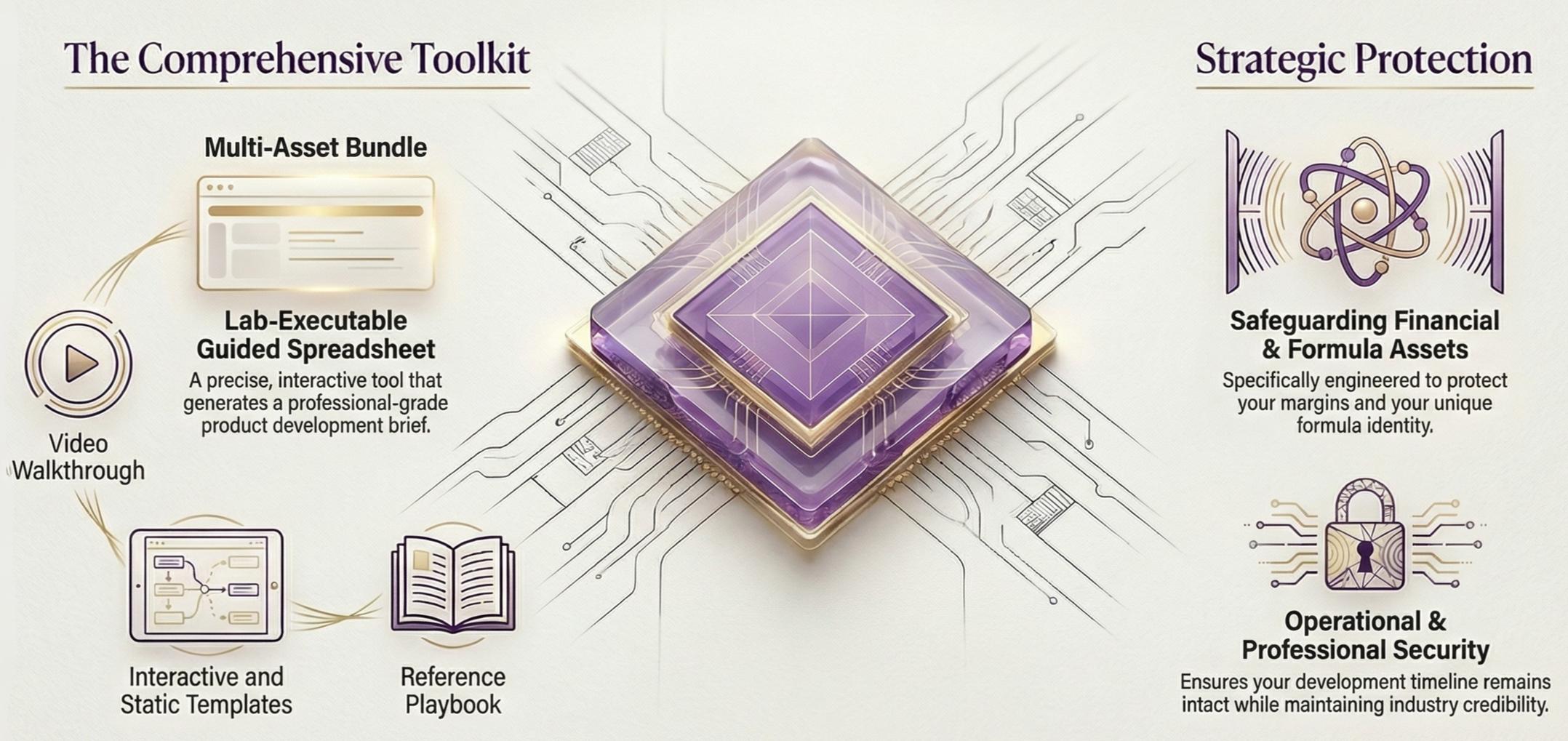
Now that you have seen the gap between your prototype and a shelf-ready product, the Lab-to-Market Strategy is the bridge across that gap
Install measurement before you commit to production.
LULUBLE Lab to Market Strategy Builder - full pack
this is what you take to stop discovering it the hard way
A Founder-grade system to give the Founder a complete, executable R&D file
The same type of file global Beauty companies build before a single production order is placed
It defines:
the non-negotiables that cannot drift
the claims that have to survive
the stability protocols that have to pass
the in-process controls that have to be measured
the stop-the-line rules that have to be honored
the handoff packs that have to be complete before a Tech Transfer begins
It replaces interpretation with defined targets.
It replaces "maybe" with method-controlled decisions.
It replaces the Founder's exposure with the Founder's authority.
This is how Indie Founders become production-strong:
not by knowing chemistry overnight,
but by using the same architecture that already protects the brands you compete with on the shelf.

Start with the PD Interactive Brief Game
&
Graduate to the Lab to Market Strategy Builder FULL PACK
1
Product Development Brief Interactive Game complementary with The Strategy
A lightweight, guided “game” that teaches you the language of professional product development through a short workflow of prompts.
Welcoming you at the door of the Strategy.
Walk through it once.
Build your first lab-grade brief in thirty minutes. Learn the language of the system before you open the workbook.
Most students complete the Welcome Interactive game in a single sitting and arrive fluent in the vocabulary the rest of the Strategy uses.
Without it, the workbook reads as a foreign country. With it, the workbook reads as your own handwriting.
2
Video Training
Judith, Luciana’s digital twin (her AI avatar), performs a walkthrough showing you how to complete the 21-tab strategy workbook + the AI Acceleration layer for governed prototyping + vendor scorecards and sample-handoff packs to make every quote real, and how to deliver it to a CMO so the project stays inside your control space.
3
The Playbook (Reference Guide)
A field-by-field guide explaining what each workbook tab means, why it matters, how labs interpret it, and what breaks when it’s missing
The Playbook is what turns the workbook from a spreadsheet into an instrument. Where the workbook asks the question, the Playbook teaches you to defend the answer
4
The Strategy Workbook
(the operating system itself)
21 tabs governing every decision between prototype lock and first production batch. Non-negotiables that cannot drift. Claims that have to survive a regulator. Stability protocols with defined conditions and acceptance criteria. CMO readiness checklists that make quotes real. Stop-the-line rules with enforceable language. Tech transfer handoff packs that prevent silent assumption.
Each tab carries a decision rule, a sign-off line, and a vendor scorecard. Nothing on the tab is optional. Nothing on the tab is left to interpretation.
If it is not written, it is not real. If it is not measurable, it cannot be enforced.
5
The AI Acceleration Layer
A structured prompt library and decision framework that lets you use generative AI as a junior R&D associate without it inventing claims, hallucinating safety data, or pulling formulations from sources you cannot defend. The same layer Luciana uses to accelerate her own intake calls.
The AI Layer is what makes the Strategy faster than the old way of doing this work and more rigorous than the old way of doing this work. Both, not one.

A Founder-grade operating system to govern:
Non-negotiables that cannot drift between bench and shelf
Claims that survive a regulator, a retailer, and a competitor
Stability protocols with defined conditions and acceptance criteria
CMO readiness checklists that make quotes real
Stop-the-line rules with enforceable language
Tech transfer handoff packs that prevent silent assumption
Built so you can negotiate, troubleshoot, and refuse with the same authority as the senior operator the CMO expected, even when she is not in the room.

Who is this for?
The Lab-to-Market Strategy is not for everyone
It is for the founder who is ready to stop discovering what she did not know to ask, and start operating with the same architecture Global Beauty companies use to protect their shelf.
Read the list below
If you see yourself, you are in the right room.
Founder / Brand Owner:
You have a working prototype. You have a launch date. You have a budget you cannot afford to spend twice. You need speed, control, and a pathway that prevents the expensive surprises you have already heard other founders describe.The Strategy gives you the same operating system a senior R&D operator would enforce without hiring one.
Brand Manager / Innovation Lead:
You inherit briefs that were written before you arrived. You hand them to labs that interpret them differently than you do. You spend half your week reconciling assumptions across vendors.The Strategy gives you a repeatable intake system and vendor scorecards that no manufacturer can rewrite in their favor.
R&D Lab Partner / Cosmetic Scientist:
You receive briefs that ask you to invent specifications the Founder should have already locked. You spend twelve hours building the missing structure before you can begin actual chemistry.The Strategy hands you a finished brief on day one with non-negotiables, claims plans, stability protocols, and acceptance criteria already defined.
Regulatory / Claims / Compliance:
You see launches collapse because the proof plan was built after the marketing copy. You see recalls triggered by claims no one validated.The Strategy installs evidence mapping and documentation discipline at the brief stage, so claims survive a regulator, a retailer, and a competitor before they ever appear on a label.
FAQs
The Lab to Market Strategy is designed for topical formulations developed in an R&D lab (creams, lotions, gels, serums, balms). The structure generalizes across categories because it governs identity, specs, packaging constraints, evidence mapping, and testing regardless of aesthetic positioning.
Is this only for skincare?
1
No.
It replaces ambiguity. The Lab to Market Strategy is built to help you start thinking about these specs and to have a conversation about them with a cosmetic scientist. The key is to define the target identity and decision rules early, so iteration stays inside your control space and not the lab's interpretation of it.
Will this replace hiring a cosmetic scientist?
2
I have already launched a product. Is the Lab to Market Strategy still relevant?
3
Yes and often more urgently.
Founders who have already launched usually arrive at the Strategy after experiencing the specific failures it prevents: a CMO substitution they did not authorize, a stability surprise after the first batch, a regulator letter, a retailer's claims review. The Lab to Market Strategy is designed to retrofit an existing product as much as to launch a new one. The work is the same in either direction: name the non-negotiables, lock the evidence, defend the architecture.
I don't have a stable prototype yet. Is the Lab to Market Strategy the right layer?
4
Not yet.
If your prototype is not stable, the PD Brief System is the architecture you need first. The PD Brief locks the identity, claims, and specification decisions that have to be defined before the prototype is built. Once the prototype is stable, the Lab to Market Strategy is the next layer: it firms the architecture around the prototype so the formula survives translation to a CMO.
The Sovereignty Trilogy is sequential by design. PD Brief comes first. Lab to Market Strategy comes second. The Tech Transfer Dossier is the third installment, the one the CMO meets.
The Welcome Interactive PD Brief Game takes about 30 min. The Playbook is structured so you can read the entire translation layer in a focused weekend. The Workbook is filled progressively across the Product Development cycle: each tab is sequenced to the moment in the project where its decisions become operational. None of it is meant to be read in one sitting. All of it is meant to be carried into rooms where it does the work.
How long does it take to implement?
5
Your access to the full Lab to Market Strategy environment is 12 (twelve) months from the date of purchase. During that period you build your work inside it: your filled brief, your completed workbook, your vendor scorecards, your stability protocols, your handoff packs and you download each artifact to your own computer and/or your own cloud as you go. LULUBLE Academy hosts the teaching environment, not your work. Your files live on your machine, and/or in your cloud, under your control. After the twelve-month access window closes, the teaching environment expires; your downloaded artifacts belongs to you in your computer/cloud environment.
How long do I have access to the teaching environment?
6
You receive immediate access to the full Lab to Market Strategy content inside the LULUBLE Academy. The Welcome Interactive PD Brief Game opens first. The Playbook, the Workbook, the Founder Decision Tools, and the AI Acceleration Layer unlock in sequence, so the architecture is metabolized in the order Luciana would teach it inside her office.
What happens after I purchase?
7
What is the refund policy?
8
If the content is not what you expected, email academysupport@luluble.com within 7 (seven) days for a full refund, no questions asked.
After 7 (seven) days, all sales are final.

What a defined pathway builds:
Sensory identity: the tack, slip, finish, and absorption that made the prototype premium drift under industrial mixing silently.
Stability: preservative systems that pass at lab scale fail at production scale; lots that pass quarterly stability fail in transit.
Claims defensibility: marketing copy outpaces the proof plan, and one regulator letter turns a launch into a recall.
CMO trust: an unprepared founder becomes the CMO's hardest client and the first one deprioritized when capacity tightens.
Margin: every reformulation between prototype and production batch costs $5K–$15K, and most launches require two or three.
The Lab to Market Strategy installs the architecture that prevents the small, silent changes that compound into rework,
and prevents the rework that compounds into margin erosion.
Stop paying for chaos
In 2026, your advantage isn’t a moodboard whether you’re launching your first product or optimizing your tenth.
Your advantage is sovereign architecture: cleaner strategy, faster decisions, and your product materially harder to compromise.
This is the scientist-at-the-table system.
Spreadsheet Workbook + Built-in Tools + Playbook + Video Training