Before you hand your formula to a CMO
See the 18 modules a Master Formulator hands to the Contract Manufacturer first
No 'normal at scale.'
No 'same INCI substitutions.'
No undocumented process changes AFTER you paid for production.
Before you sign a CMO contract on a formula you believe is ready, see the gap a Master Formulator measures first
13 questions - 5 minutes
See whether your formula is ready to survive the CMO handoff
Free.
Yours to keep.
Your approved sample is not enough
At scale:
Heat transfer changes
Shear changes
Cooling changes
Packaging behavior changes
Procurement pressure begins
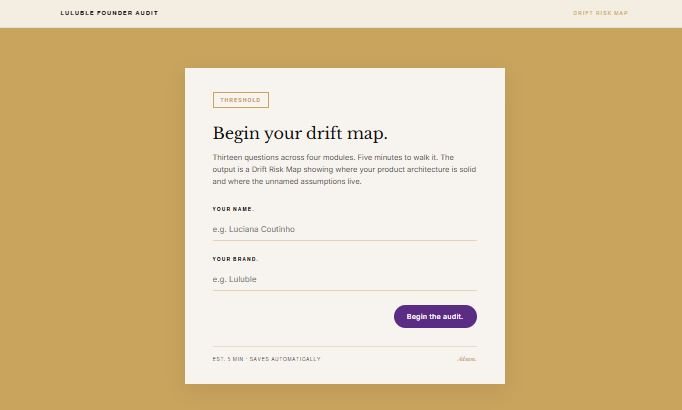
Drift Risk Map
names where your architecture leaks
The Tech Transfer Dossier
is what you take to the CMO
when you have already named the leak
If the Drift Risk Map named a leak in your architecture
The Readiness Score quantifies the gap between where you are and where the CMO needs you to be
Score your readiness from 0 to 100
Plus the readiness band:
Ready
Forming
Soft
or Drifting
that tells you whether the CMO conversation is the right next step
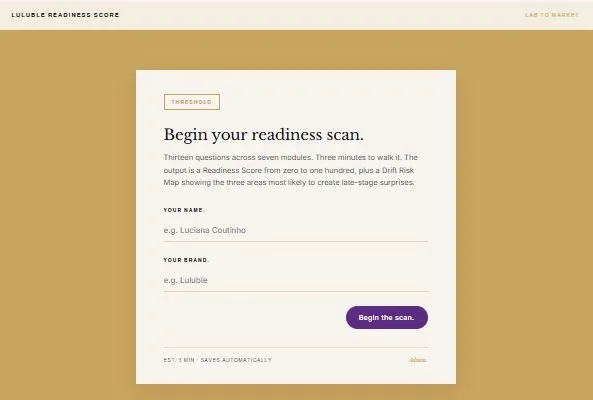
13 questions
5 minutes - reveals your highest-risk gaps
What is the LULUBLE Tech Transfer Dossier (TTD)?
This is not a recipe.
This is a governance instrument.
The LULUBLE Tech Transfer Dossier turns your approved lab batch into a founder-side manufacturing control system. It helps you define: (1) what the product is; (2) what must not change; (3) which materials are locked; (4) which process parameters matter; (5) how the factory must measure pass/fail; (6) what documentation the CMO must provide; (7) what requires written approval; (8) when the batch must stop; (9)what “same product” actually means before scale-up begins. In the course source material, the Dossier is described as the founder’s manufacturing control system: it prevents the CMO from filling missing details with assumptions, creates documented change control, and allows the founder to say, “If it’s not in the TTD, it’s not approved.”

The enemy is not your CMO
It is the untranslated formula
Topical formulations do not survive industrial manufacturing because Founders trusted their lab too much and their documentation too little.
They fail because:
The formula is "ready" at the bench but has never been translated into specifications a CMO can execute without interpretation.
The CMO swaps a raw material because the change control rule did not exist.
The cooling rate at scale is 4× slower than the bench, and the resulting crystal growth changes the texture.
The packaging passed compatibility in the lab pouch but fails in the production tube six months after launch.
The CMO calls it "normal at scale" because no one wrote down what "not normal" looks like.
The phrase that signals you have lost control is small.
It is "normal at scale."
It is "we made a like-for-like substitution."
It is "that raw material supplier is no longer available."
By the time you hear those sentences, the batch is already in tanks, the inventory is already labeled, and the cost of correction has already been priced into your launch.
In 2026, buyers and regulators reward proof, not just aesthetics.
The shelf is the evidence.

If it is not in the dossier, it is not approved.
If it is not measurable, the contract manufacturer will
measure something else.
Without a Tech Transfer Dossier:
You hand over a formula card:
The CMO quotes from incomplete assumptions.
Procurement suggests equivalent materials.
The process engineer copies RPM instead of scaling shear.
Packaging compatibility is treated as decoration.
The batch passes basic QC.
YOU SAY: “It feels different.”
Then YOU start negotiating with symptoms.
With a Tech Transfer Dossier
You enter the CMO conversation with:
a defined product identity
required exhibits
process parameters
material controls
acceptance criteria
kickoff agenda
change-control forms
stop-the-line rules
YOU do not ask the factory to guess.
YOU hand them the system.
The Tech Transfer Dossier (TTD) is designed to sit on the Founder's side of the table as a Master Formulator's proxy:
written, measurable, enforceable, in the batch record.

Now that you have seen the gap between your prototype and a production batch, the Tech Transfer Dossier is the bridge across that gap
Install measurement before you install a CMO.
LULUBLE Tech Transfer Dossier (TTD) - full pack
this is what you take to stop discovering it the hard way
A Founder-grade operating system to govern:
The same control architecture Global Beauty companies enforce
before a single commercial batch is approved
It defines:
the 18 modules of a manufacturing control system that cannot drift
the 9 exhibits your Developing Lab must hand over before kickoff
the 6 appendices the CMO must sign before they touch a tank
the CQA → CMA → CPP map that ties identity to measurements to controls
the IPC matrix with stop-the-line triggers in writing
the change control log that prevents silent substitution
the FMEA register that names failures before they happen
the AMT tracker that calibrates the yardstick between your lab and the CMO's
It replaces interpretation with specifications.
It replaces "minor change" with governed change.
It replaces the Founder's exposure with the Founder's authority.
This is how Indie Founders survive Tech Transfer:
not by hiring a Chief Operations Officer overnight,
but by using the same dossier Global Brands hand to their CMOs before a single commercial unit is poured.

Start with the Drift Risk Map
Continue with the Readiness Score
&
Graduate to the Tech Transfer Dossier (TTD) FULL PACK
1
Video Training
Judith, Luciana's digital twin, walks you through the 18 modules: how to demand the right exhibits from the Developing Lab before kickoff, how to populate the dossier without leaving manufacturing gaps the CMO can quietly fill, how to use the appendices to keep substitutions, equipment changes, and process drift inside written governance.
The Video Training is how the Master Formulator's posture transfers: not the chemistry, the discipline.
2
The Playbook (the FULL 18-module Reference Guide)
A module-by-module guide explaining what each control means, why it matters, how the CMO will try to reinterpret it, and what breaks when it is left undefined.
The Playbook is the translation layer between the language of an R&D lab and the language of an industrial factory. Without it, the dossier reads like a chemistry exam. With it, the dossier reads like the manufacturing contract the CMO already signed.
3
The Tech Transfer Workbook (8-tab operating system)
A structured workbook you can use to organize the product’s formula identity, specifications, process assumptions, material requirements, packaging compatibility, scale-up controls, and CMO handoff rules.
The required Exhibit Pack in the Dossier includes Exhibits A through I — formula card, INCI breakdown, label ingredient list, lab process, stability summary, package compatibility, formula costing, supporting documents, and product specifications — because these become the source of truth the CMO must follow.
No exhibits, no kickoff.
Exhibit A — Final Formula Card
The formula card that defines the formula by INCI, function, CAS/EINECS where applicable, and percentage.
This is the version the CMO is allowed to manufacture.
Exhibit B — INCI Function & Breakdown
The breakdown that clarifies raw material composition, blend structure, supplier information, function, and true INCI contribution.
This is where “same INCI” starts becoming technically visible.
Exhibit C — Label-Ready Ingredient List
The ingredient list in descending order, prepared for label and regulatory alignment.
Exhibit D — Laboratory Process
The lab process: phases, order of addition, temperatures, mixing methods, RPM ranges, time, pH checkpoints, equipment list, remedials, warnings, and process checkpoints.
Exhibit E — Accelerated Stability Testing Summary
The stability record that shows how the product behaved across time and conditions before the CMO touches it.
Exhibit F — Package Compatibility Report
The product-plus-pack evidence: appearance, odor, function, packaging behavior, and compatibility observations.
Exhibit G — Formula Costing
The formula cost structure at MOQ, including material contributors and cost drivers.
10. Exhibit H — Supporting Documents
COAs, SDSs, IFRA statements, allergen lists, micro challenge results, HRIPT, packaging specs, equipment photos/spec sheets, regulatory documentation, and other required supporting evidence.
11. Exhibit I — Product Specifications
Release specifications and identity specifications from the gold standard approved lab batch: appearance, color, odor, pH, viscosity, specific gravity, micro limits, test methods, instruments, and SOP references.
THE CONTROL MODULES
The Dossier protects the product where scale-up usually breaks it. Use this as an accordion or stacked cards.
Product identity
Define the gold standard reference batch, sensory identity, product system, target consumer experience, and what “same product” means before anyone changes the process.
QTPP, CQAs, CMAs, and CPPs
Translate founder language into manufacturing language: quality target profile, critical quality attributes, critical material attributes, and critical process parameters.
The founder translation is simple: these are the non-negotiables that protect product identity.
Formula and label identity
Lock the formula, INCI breakdown, label ingredient order, material grades, supplier logic, and cost drivers so quoting and manufacturing cannot quietly alter the product.
Equipment mapping
Compare lab equipment to CMO equipment. Define vessel type, mixer, homogenizer, heating/cooling system, tip speed, power per volume, turnover, and scale-up basis.
Thermal profile
Define heating and cooling as structural variables. The factory cannot optimize throughput at the expense of texture.
CPP list and control strategy
Identify the few process parameters most likely to rewrite the product: cooling rate, homogenization strategy, mixing equivalency, fill temperature, and maximum hold time.
In-process controls (IPCs)
Define what must be checked during manufacturing, not after the damage is already done.
Analytical Method Transfer (AMT)
Make sure the CMO and lab are using comparable methods and instruments, so “pass” and “fail” mean the same thing on both sides.
Batch ladder and go/no-go gates
De-risk production in stages: lab, pilot, engineering, validation, commercial.
You do not learn on full launch inventory.
Deviation and change control
Define how problems are reported, investigated, corrected, and approved.
No informal fixes.
No undocumented substitutions.
No rescue attempts that create a new product wearing the old name.
If it is not in the workbook, it is not in the batch record. If it is not in the batch record, it did not happen.

Install a manufacturing control system to govern:
The LULUBLE Tech Transfer Dossier gives your CMO a complete, executable manufacturing system and gives you a governance structure to keep the product on-spec as it scales.
It replaces interpretation with defined parameters, and replaces "minor change" with method-controlled governance.
This is how founders become sovereign at scale: not by learning manufacturing engineering overnight, but by using the same dossier the largest beauty companies in the world hand to their CMOs before they pour the first commercial unit.

Who is this for?
Who is this NOT for?
Read this list below.
If you see yourself, this is the right room
THIS IS FOR YOU IF:
You have an approved formula, stable prototype, or gold standard lab batch.
You are preparing to request CMO quotes.
You are reviewing a manufacturing agreement or quality agreement.
You are transferring from a formulating lab to a contract manufacturer.
You have heard “normal at scale” and do not know how to challenge it.
You suspect the manufacturer may substitute raw materials, packaging, or process conditions.
You want to walk into the CMO kickoff with structure, not scattered email threads.
You are not trying to micromanage the factory.
You are trying to define the system clearly enough that the factory can reproduce the product without silently rewriting it.
Use the Tech Transfer Dossier when the formula is ready to meet the CMO.
WHO THIS IS NOT FOR
Do not buy this first if:
You do not know what product you are building yet.
You have not clarified claims, market, sensory identity, packaging direction, or cost target.
You do not have a stable prototype or approved lab sample.
You are still choosing between product formats.
You have not completed a Product Development Brief.
You need a formulator to create the formula from scratch.
Start with the PD Brief System if the product is still undefined.
Start with the Lab-to-Market Strategy if you have a prototype but not a full pathway to shelf.
Founder / Brand Owner preparing for first commercial batch:
You have a prototype that works. You have a CMO who is quoting. You have a launch date the retailer cannot move. You have a budget you cannot afford to spend twice. You need a manufacturing system the CMO cannot quietly reinterpret.
The Dossier gives you the same control architecture a Chief Operations Officer would enforce without hiring one.
Founder / Brand Owner already in production, already burned:
You launched. You shipped. Something changed between the lab batch and the production batch and nobody flagged it until the retailer complained, or the regulator wrote, or the customer noticed the texture drift. You do not want it to happen again.
The Dossier is built to retrofit an existing CMO relationship as much as to start a new one. The work is the same: name the controls, lock the governance, defend the architecture.
R&D Lab Partner / Cosmetic Scientist handing off to a CMO:
You spent six months developing a formula and now you are watching a CMO who is not on the Founder's payroll quietly redesign the manufacturing process.
The Dossier gives the CMO the 9 exhibits they need to execute without inventing, and gives you the change control rule that protects the formula identity you spent six months locking.
FAQs
No. The Tech Transfer Dossier is designed for topical formulations developed in an R&D lab and scaled to industrial manufacturing — creams, lotions, gels, serums, balms. The structure generalizes across categories because it governs identity, measurement, process control, and governance regardless of finished-product aesthetics.
Is this only for skincare?
1
Will this replace hiring a cosmetic scientist, COO, quality consultant, or a process engineer?
2
No. This does not replace qualified technical experts. It gives you a founder-side framework so you know what to request, what to review, what to question, and what must be defined before the CMO starts interpreting gaps. Use it to become a better client, a better decision-maker, and a stronger owner of your product architecture. This helps you engage with the right experts and ask the right questions if this is not your area of expertise.
I do not have a stable prototype yet.
Is the Tech Transfer Dossier the right layer?
3
No. If you do not have a stable prototype, you need the PD Brief System first. If you have a stable prototype but the architecture around it (specs, claims, stability, packaging, CMO readiness) is still soft, you need the Lab to Market Strategy before the Dossier. The Sovereignty Trilogy is sequential by design. Tech Transfer is the third installment, not the first.
The 18 modules are sequenced to the order in which the decisions become operational. Most founders complete Modules 0–7 (Quick Start through Thermal Profile Control) before the first CMO kickoff call. Modules 8–18 (Manufacturing Process Flow through Change Control) are populated across the first engineering and validation batches. The Workbook fills progressively across the scale-up cycle. None of it is meant to be read in one sitting. All of it is meant to be carried into the rooms where the CMO is.
How long does the Tech Transfer Dossier take to populate?
4
The Dossier turns every negotiation into a documentation conversation. The CMO cannot tell you that your spec is "too tight" if your spec is in the Workbook with target, alert, and action limits and a method ID. The CMO cannot tell you a substitution is "like-for-like" if Appendix A defines what like-for-like requires. The Dossier installs enforceable language so the CMO meets the Founder's authority instead of the Founder meeting the CMO's process.
How does this help with CMO negotiations?
5
Does this guarantee my product will scale successfully?
6
No. No template can guarantee scale-up performance. The Dossier helps you reduce preventable drift by defining the product, process, materials, methods, documentation, change control, and decision gates before manufacturing pressure begins. It gives you a stronger system. It does not remove the need for technical judgment, testing, qualified partners, and responsible execution.
You receive immediate access to the full Tech Transfer Dossier inside the LULUBLE Academy. The Video Training, the Playbook, the 8-tab Workbook, the Appendices, and the Founder Command Center unlock in sequence, so the architecture is metabolized in the order a Master Formulator would teach it inside her office.
What happens after I purchase?
7
Is this legal advice?
8
No. The Quality Agreement Clause Bank is educational and operational. It is designed to help you communicate requirements to your attorney and CMO. It does not create an attorney-client relationship and does not replace legal review by qualified counsel.
The Dossier source material includes the same boundary: LULUBLE is not a law firm, does not provide legal advice, and the clause language must be reviewed and customized by a qualified attorney for the product, jurisdiction, regulatory status, markets, and risk profile.
How long do I have access to the teaching environment?
9
Your access to the full Tech Transfer Dossier environment is 12 (twelve) months from the date of purchase. During that period you build your work inside it: your filled dossier, your completed workbook, your CMO kickoff agenda, your change control log, your FMEA register, your AMT tracker, and you download each item to your own computer and/or your own cloud as you go. LULUBLE Academy hosts the teaching environment, not your work. Your files live on your machine, and/or in your cloud, under your control. After the twelve-month access window closes, the teaching environment expires; your downloaded items belong to you in your computer/cloud environment.
What is the refund policy?
10
If the content is not what you expected, email academysupport@luluble.com within 7 (seven) days for a full refund, no questions asked.
After 7 (seven) days, all sales are final.

How the Tech Transfer Dossier works:
Step 1: Collect the source-of-truth Exhibit Pack.
Before you engage a CMO, collect Exhibits A–I from your R&D or developing lab.
If an Exhibit is missing, you are negotiating blind.
Step 2: Populate the control modules.
Define product identity, specifications, formula, materials, equipment mapping, thermal profile, CPPs, in-process controls, analytical method transfer, batch ladder, deviation rules, and change control. Work with qualified technical experts if this is not your area of expertise.
When a CMO scales a formula and produces a 50,000-unit batch that fails stability, the conversation that follows is not about who is at fault. It is about what was written. Do the math.
Step 3: Run the CMO kickoff.
Use the CMO kickoff agenda to align the contract manufacturer, QA, QC, production, engineering, and your team before the pilot or engineering batch begins.
The Dossier’s kickoff agenda includes confirming the gold standard batch, CQAs, rheological fingerprint, raw material lock, equipment mapping, thermal profile, IPC matrix, packaging compatibility, AMT plan, batch ladder, go/no-go gates, and change-control timelines.
Step 4: Substitutions and process changes are written and reviewed.
Use Appendix A and Appendix B when the CMO asks for raw material substitutions, equipment changes, process changes, or “like-for-like” replacements.
Step 5: Do not proceed to commercial runs until the gates are satisfied.
Engineering, validation, and commercial production are different thresholds.
The Dossier helps you stop treating launch inventory as the experiment.
Stop handing off formulas.
Start handing off control.
In 2026, your product is not just chemistry.
It is a physical system: heat, shear, time, material identity, packaging behavior, testing, documentation, and governance.
If it is not written, it is interpreted.
If it is not controlled, it drifts.
If it is not in the Tech Transfer Dossier, it is not approved.